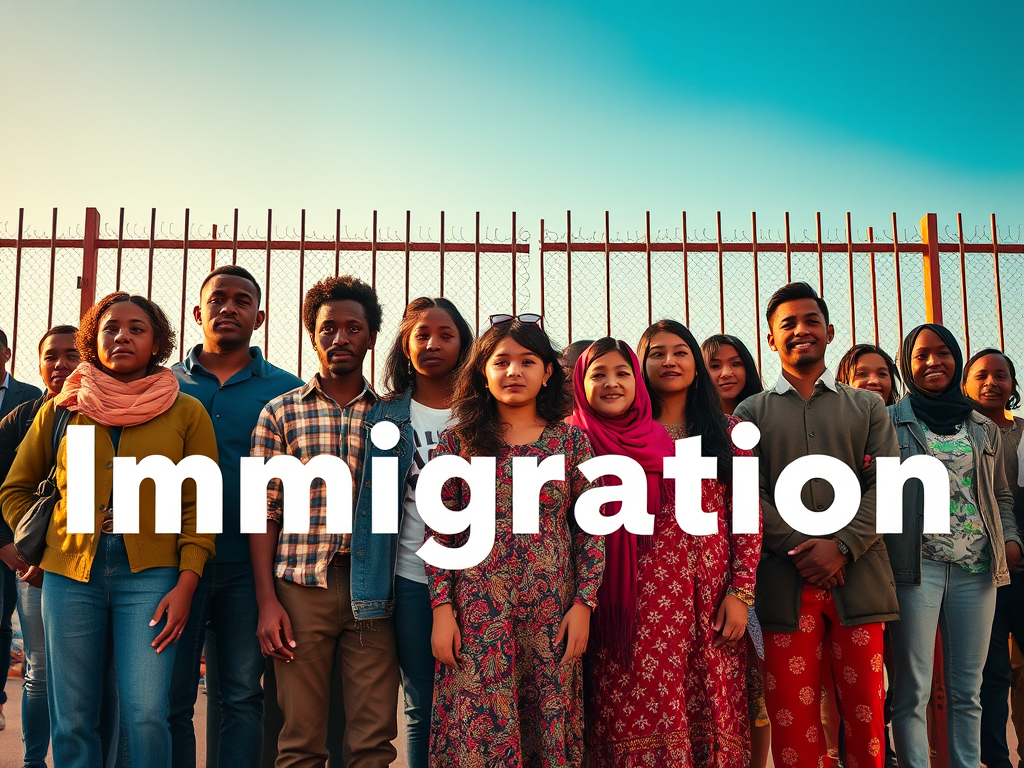
Immigration has become one of the most fiercely debated topics in modern politics. It’s a subject that dominates headlines, divides political parties, and often finds itself discussed—loudly and emotionally—at kitchen tables, pub counters, and on debate stages. The reasons are obvious: immigration touches on identity, economics, safety, and belonging. It reshapes the population, redefines national character, and challenges our understanding of who we are.
And yet, for me, the conversation is also deeply personal.
I am the child of an immigrant. My very existence is proof that borders can be crossed, that systems can welcome, and that lives can be built as a result of immigration. Without the policies that allowed my dad to come to the UK and plant roots, I simply wouldn’t be here. That admittedly makes me biased when discussing this topic but it also makes me determined to approach this topic with honesty, nuance, and fairness—acknowledging both its challenges and its profound potential.
Let’s begin with the language.
The Oxford definition of immigration is “the action of coming to live permanently in a foreign country.” But when you strip away the wording, it’s clear that not all immigrants are treated the same. Take, for example, the term “expat”—defined as “a person who lives outside their native country.” Functionally, these definitions are identical. But socially and politically, the terms carry different weight. Westerners retiring in Portugal, sipping wine in gated communities where English is the dominant tongue and the culture remains untouched, are labelled “expats.” Their presence is seen as aspirational, even enviable. Meanwhile, a family fleeing war in Syria or political persecution in Eritrea, seeking safety in the UK and learning the language to build a new life, are often viewed with suspicion—if not hostility.
The discrepancy isn’t linguistic. It’s racial.
It’s also deeply ironic. The British themselves are no strangers to international movement—historically through empire and colonisation, and now through business, tourism, and retirement. And yet, when the movement is inward rather than outward, when the skin is darker or the accent less familiar, the tolerance seems to vanish.
Of course, this is where defenders of tradition will raise concerns about national identity, British values, and the idea of cultural dilution. “What does it mean to be British?” they ask. “Aren’t we losing what makes us who we are?” But this question ignores a fundamental truth: culture is not a fixed monument. It is a living, breathing thing—fluid, malleable, and always evolving.
The customs and values we call “British” today would be alien to our ancestors even a century ago. Once, British values included institutionalised classism, racism, and the subjugation of women. Now, they include equality, tolerance, and multiculturalism. That evolution is not a threat; it’s a triumph.
As the satirical quote goes: “Being British is about driving a German car to an Irish pub to drink Belgian beer before going home to a Swedish sofa to eat an Indian takeaway while watching American TV—only to then be suspicious of anyone foreign” Britishness is, and always has been, a tapestry of borrowed threads. That’s what makes it beautiful.
But I do not pretend that immigration is free of complications.
We must recognise the real pressures placed on housing, schools, and public services when population growth is rapid. We must also acknowledge the fear and disorientation people feel when the familiar starts to look unfamiliar. These concerns shouldn’t be dismissed—they should be addressed through intelligent policy, investment, and honest communication.
Yet, we must also challenge the narrative that immigrants are “taking our jobs” or “clogging up the system.” The reality is that a significant number of immigrants are performing essential roles that keep the country running. According to the UK’s General Medical Council, nearly 40% of NHS doctors qualified outside the UK. From healthcare to hospitality, construction to transportation, their contributions are not just present — they’re vital. So no, Steve down the pub, Nigerians aren’t “swarming” the UK to steal your job as a junior recruiter. And they certainly didn’t edge you out of a medical degree. You were never going to be a doctor. Your three GCSEs and a BTEC in Sport are doing far more to limit your prospects than any immigration policy ever will.
Furthermore, many of the jobs immigrants are taking are roles that plenty of British citizens aren’t exactly queuing up for. They’re often tough, physical, and underpaid — work that’s essential, but routinely overlooked.
But statistics and economic arguments only go so far. We must also appeal to something deeper: our shared humanity.
When people risk their lives crossing oceans, walking through deserts, or hiding in lorries, they are not doing so for fun. They are not criminals or invaders. They are mothers, fathers, sons, and daughters who want exactly what we do—safety, opportunity, and a future. To respond to their desperation with dehumanising terms like “illegal aliens,” as Donald Trump routinely does, is to strip them of their dignity. It’s a failure of empathy.
So, what kind of society do we want to be?
One that builds walls, draws hard lines, and guards fortune as if it were birthright? Or one that recognises the lottery of birth for what it is, and strives to offer opportunity to those born on the other side of the border? To me, the answer is clear. I find it unjust that the length and quality of one’s life can be dictated solely by geography, with no option for escape, no ladder to climb, no chance to earn something better.
I do not argue for open borders without rules. I argue for empathy and humanity when considering the fact that most people in the world are not as comfortable as you or I.
Yes, let’s protect our resources. Yes, let’s be pragmatic. But let us never forget that immigration is not a threat to be managed—it is a story to be told. A story of resilience, courage, and human connection.
 The Written Mirror
Leave a comment